
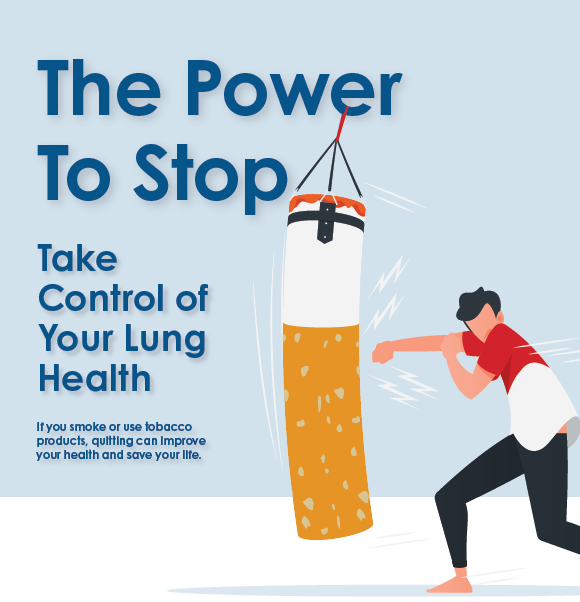
The Power To Stop: Take Control of Your Lung Health
If you smoke or use tobacco products, quitting may be one of the most important choices you ever make.
Smoking is the leading cause of lung cancer. It causes almost 9 of every 10 deaths from the disease. The smoke from cigarettes, cigars and pipes has at least 69 chemicals that can cause cancer.
Electronic cigarettes, or vaping devices, and smokeless tobacco products such as dipping and chewing tobacco also contain chemicals that can cause cancer. This is why the Centers for Disease Control and Prevention (CDC) says there are no safe tobacco products.
If you smoke, you are placing the people around you at risk. Secondhand smoke — or smoke from your burning tobacco that is inhaled by people nearby — can lead to cancer over time.
Get Screened
The CDC says you should be screened for lung cancer if:
-
You smoke now.
-
You have quit within the past 15 years.
-
You are between 50 and 80.
You should also be screened if you have a 20 pack-year smoking history. A pack-year measures how much someone has smoked over time. It is calculated by multiplying the number of packs smoked per day by the number of years smoked. A 20 pack-year history could mean smoking one pack per day for 20 years or two packs per day for 10 years.
Your doctor will screen you for lung cancer with a low-dose CT scan, a type of X-ray. It only takes a few minutes.
Talk to your doctor to see if getting screened is right for you.
Take Back Control
Trying to quit can make you feel powerless. That’s because tobacco products contain an addictive chemical called nicotine. Over time, your body and brain get used to nicotine. This can give you withdrawal symptoms when you try to quit.
Symptoms include:
-
Cravings.
-
Feeling angry or restless.
-
Feeling anxious or depressed.
-
Trouble focusing.
-
Trouble sleeping.
The good news is there are many resources that can help you quit.
Nicotine replacement therapy (NRT) products contain low doses of nicotine. These doses don’t have the toxins found in other tobacco products. They can help you control cravings and other withdrawal symptoms as you quit smoking. NRT can increase your chances of quitting by 50 – 70 percent.
NRT products include:
-
Patches.
-
Gums.
-
Lozenges.
-
Inhalers.
-
Nasal sprays.
Be sure to use NRT products as instructed. You will use most of these products for 8 – 12 weeks.
Medications such as varenicline and bupropion can also help you control cravings as you quit. These are only available by prescription.
Finally, you might consider counseling. It can address the mental, emotional and social aspects of quitting. You can talk to a counselor one on one or join a quitting program.
If you are thinking about quitting, talk to your doctor. He or she can help you choose a product, medication and approach to quitting that is right for you.
You have more power than you think you do. Take control of your lung health today.
The CDC is an independent organization that provides health information you may find helpful.
[Sources, accessed March 10, 2025]
How to Quit Smoking | Smoking and Tobacco Use | CDC
Nicotine Replacement Therapy (NRT): What It Is & How It Works
7 Common Withdrawal Symptoms | Quit Smoking | Tips From Former Smokers | CDC
Tobacco and Cancer | Cancer | CDC
Screening for Lung Cancer | Lung Cancer | CDC
Smoking Cessation: Fast Facts | Smoking and Tobacco Use | CDC
*Statistics and information are accurate as of the time of publication and may change over time.